
Every Monday, your team gets a briefing on your market: competitors, customers, suppliers, approvals, regulation, studies, startups and deals. Built around your company. Read in ten minutes.
For owners, executives, product and innovation managers at MedTech SMEs.
From a customer, who mentions a competitor's new product.
At the next trade fair, months after the deal was announced.
From a regulator's deadline that nobody on the team was tracking.
Large companies have market intelligence teams. Now your team gets the same view, every Monday.
What lands in your inbox
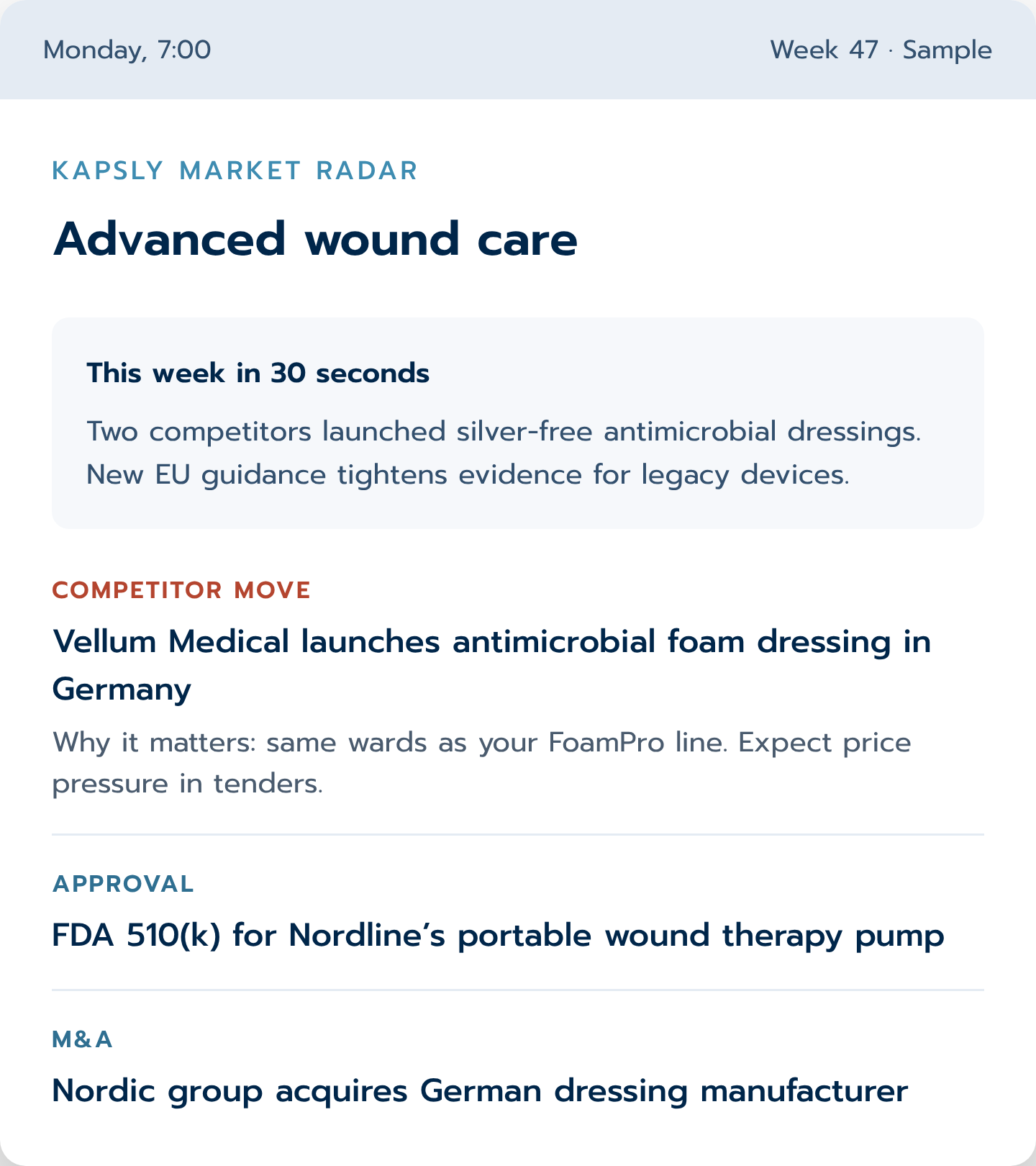
Shown for a fictional maker of wound care products. Yours is built around your products, competitors and markets.
Vellum Medical launches a silver-free antimicrobial foam dressing in Germany, priced below the market leader.
Why it matters: Same wards as your FoamPro line. Expect price pressure in German tenders.
Helvia Kliniken, one of your key hospital customers, joins a new buying group with two other hospital chains.
Why it matters: Prices will be negotiated centrally from next year. Prepare your offer early.
Polyfoam, your main foam supplier, announces it will close its plant in Belgium.
Why it matters: Supply risk for your FoamPro line. Check second sources now.
FDA 510(k) clearance for Nordline’s portable negative pressure wound therapy pump. New MDCG guidance on clinical evaluation.
Why it matters: Nordline can now sell in the US. Check your MDR timeline for legacy devices.
Randomised trial from a university hospital compares two dressing types for diabetic foot ulcers in 300 patients.
Why it matters: Evidence your sales team can use, or will hear from competitors.
Basel startup Sensaro raises CHF 6 million for a sensor that monitors wound healing.
Why it matters: A possible partner for a smart dressing, or a future competitor.
A Nordic medical group acquires a German dressing manufacturer with 150 employees.
Why it matters: A stronger rival in DACH hospitals, and a valuation benchmark for your segment.
Public tender for wound care consumables at a Swiss cantonal hospital. Deadline in four weeks.
Why it matters: A sales opportunity your team might otherwise miss.
Who is buying whom, who is raising money, and what that means for the value of your company.
What your key customers and suppliers are doing: new buying groups, expansions, price changes, plant closures.
Competitor launches, approvals and pricing signals, early enough to adjust your roadmap.
Startups, university research and new technologies in your field, ready for partnering or scouting.
How it works
Your competitors, customers and suppliers, and the technologies that could change your market. Two minutes in a short form.
We review your request. If it's a match, we search hundreds of sources in many languages and send you your first briefing within 1 to 2 weeks.
We adjust it to your feedback and maintain sources and rules. It arrives every week, to everyone you name.
Already running in health tech
The MEDKAP Market Brief uses the same engine every week for health-tech investors and corporates in the DACH region.
Subscribe to the MEDKAP Market BriefFor your own team. Start here.
CHF 89 / month
One price for your whole team, up to 10 recipients. Minimum 3 months, then cancel any month. EUR 89 in Germany and Austria.
Share insights with your customers.
On request
Send us your request. If it's a match, we build your first briefing from public sources and send it to you within 1 to 2 weeks. Free, no commitment.
Your competitor list stays confidential. It is used only for your briefing.
Your first briefing is free. If it doesn't tell your team something new, you've lost two minutes.